

How ERP Power is Leading the Industry Into the Next Era of Efficiency, Density, and Design Freedom
In the lighting industry’s pursuit of higher efficiency in power conversion, Gallium Nitride (GaN) technology—a wide-bandgap semiconductor material traditionally used in power electronics like EV chargers and solar micro-inverters—is rapidly displacing traditional silicon. GaN-based power devices are more efficient than silicon-based devices and can reduce power loss by up to 80%.
While GaN technology has been used in the commercial sector since the early 2000s, it has only recently become a viable solution for use in applications like LED drivers. For LED drivers, this wide-bandgap semiconductor material delivers superior performance in speed, efficiency, and power handling, allowing for much smaller, lighter, and more energy efficient components.
ERP is pioneering this adoption, integrating GaN into its next-generation LED driver platforms and setting a new standard in power density, efficiency, and lighting design flexibility.

An Evolution in Power Topologies
ERP has long been a leader in delivering big power in small sizes—packing precision lighting capabilities and tunable color into the industry’s smallest footprint.
Several years ago, ERP introduced its Gen-1 silicon-based two-stage half-bridge LLC topology (boasting ~89% efficiency), adapted from the computing sector and widely used in platforms for Apple and Dell (among others). This driver topology has empowered lighting professionals with the flexibility to create unique lighting fixtures with minimal size constraints.
GaN has now taken that capability to the next level. In a major topology shift, ERP is now introducing its innovative Gen-2 GaN-based Progressive Boost Platform in several brand new LED driver families.
The Progressive Boost topology uses a patented two-stage converter that leverages high-frequency GaN integrated circuits (ICs) at its core.
- Stage One (Variable Boost): Manages alternating current (AC) line input and harmonic distortion, delivering a targeted regulation point.
- Stage Two (GaN Flyback Converter): Provides wide input/output voltage ranges with high efficiency and dynamic response.
While ERP’s previous two-stage silicon-based LLC topology is very efficient, it has a limited dynamic range as it maintains a relatively fixed input voltage and generates a narrow range of output voltage.
The Gen-2 GaN-based Progressive Boost Platform relieves that burden, consolidating what once required five separate LED driver products into a single “workhorse” platform, dramatically simplifying product design and supply chains, and improving the efficiency to ~92%.
ERP is not taking a break from innovation, however. It is currently developing a Gen-3 GaN-based technology platform utilizing a groundbreaking single-stage GaN PFC topology that is specially designed to use fewer components, be more cost effective, and even more efficient (~94%) than the two-stage Gen-2 platform. This topology will utilize specially patented and proprietary Fractional Ripple Reduction (to reduce electrical ripple) with Synchronous Rectification, further reducing thermal losses and enabling even smaller, denser drivers.
How GaN is Transforming Lighting Capabilities
In general, GaN technology delivers higher efficiency, faster switching speed (with smaller size magnetics and higher power density), lower resistance, and smaller form factors compared to silicon-based chips—ideal for modern, compact LED systems. On a larger scale, these advanced driver capabilities will enable the lighting industry to explore innovative architectural applications by designing extremely compact luminaires while realizing massive energy savings and lower manufacturing costs—all at a time when such miniaturization benefits are becoming increasingly important.
As form factors get smaller and smaller, there is less room for discrete components; however, GaN technology removes this need for discrete parts in LED drivers by assembling multiple integrated circuits and power components—such as the gate drivers, control logic, and power transistors—onto a single semiconductor chip. In a traditional silicon-based system, all these components would be incorporated as separate parts, resulting in a clunkier design.
The integration potential with GaN technology is becoming critically important; more integration means faster platform insertion, and fewer parts allow for a more compact design.
ERP’s integration of GaN technology has numerous benefits over traditional silicon-based drivers:
- Significant Efficiency Gains
ERP’s GaN-enabled new Gen-2 LED drivers achieve ~92% efficiency, compared to 88% in our Gen-1 silicon-based drivers, and around 85% in legacy designs. At this level, every incremental gain is significant; higher driver efficiency directly translates to higher lumens per watt for the end customer. - Groundbreaking Power Density
With GaN technology, ERP can achieve 25 (and potentially 30) watts per cubic inch, up from 20 watts in its prior generation and representing the highest density in the market. At this level of power density, lighting designers can enjoy more flexibility with smaller, slimmer drivers. - Design Freedom
Lighting manufacturers have been looking for a higher-density solution that has a smaller footprint; currently, LED drivers are essentially just boxes that get in the way when designing a luminaire. Since the LED driver is a necessary component, the smaller it can be designed means the more freedom manufacturers have to focus on aesthetics, ergonomics, and integration rather than accommodating bulky hardware. - Simpler, More Flexible, Lower-Cost Installations
ERP is developing compact GaN-based LED drivers that can snap onto tape-light extrusions right from the field, eliminating the need for an electrician to handle complex J-Box wiring every time a run needs expanding, This functionality signifies big changes in the way tape-light products are integrated into different lighting applications, and means lower costs on labor and materials.
| GaN Technology (Gen-2) | Current Two-Stage LLC Topology (Gen-1) | Legacy Topology | |
| Efficiency | 92% | 88% | 85% |
| Power Density | 25-30 watts per cubic inch | 20 watts per cubic inch | 8 watts per cubic inch |
ERP’s Competitive Advantage Using GaN Technology
ERP has also integrated its GaN platform into its new PLS-B series, which is a GaN-based update of its well-received PLS-A family of programmable constant current 0–10 V drivers.
This integration has resulted in significant advantages over one of ERP’s biggest competitors.
- The new PLS-B series is available in 85 W and 95 W, and (thanks to GaN) both the wattage packages use the same compact-sized case as the older 20–65 W PLS-A drivers.
In contrast, the competitor’s driver offers only an 85 W silicon-based driver for similar applications, which is housed in a case that is at least 6 inches longer than the PLS-B.
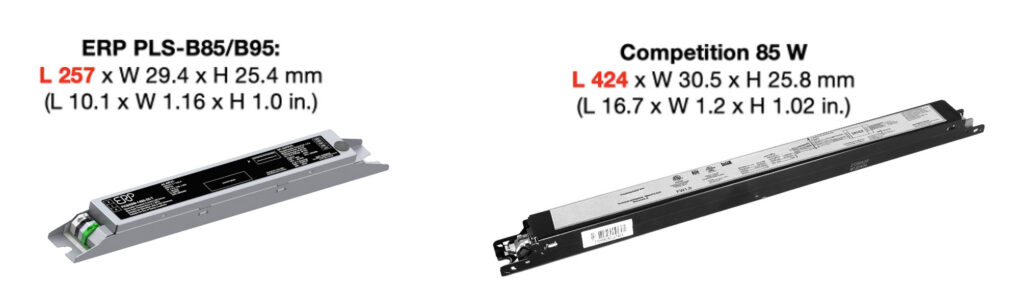
2. The thermal comparison chart below shows that the PLS-B drivers run at least 5ºC cooler than the competitor’s driver.
ERP PLS-B85W-23-55-TZ
(no aux)
| LED Driver | Temperature at Stability (ºC) |
| ERP PLS-B85 | 39.9 |
Competition 85 W LED driver
(no aux)
| LED Driver | Temperature at Stability (ºC) |
| Competition 85 W | 45.1 |

GaN Technology’s Impact on Linear and Round Aperture Lighting
The lighting market is essentially made up of two form factors:
- Round Apertures: Point source fixtures (such as downlights, track lights, and wall washers) common in residences, hospitality spaces, and commercial buildings
- Linear Fixtures: Pendants and troffers in offices, and industrial spaces
ERP covers both sides of the market with its programmable constant current LED driver platforms—the PLH (for linear fixtures) and the PRH (for round fixtures)—and is bringing GaN-driven performance to both. These drivers boast ultra-thin profiles—just 0.76 inches—while supporting up to 65 watts of output.
This leap allows ERP to set a new standard against its own legacy designs, effectively reshaping how lighting designers will approach fixture design and application and opening a new chapter for linear and round aperture lighting capabilities.

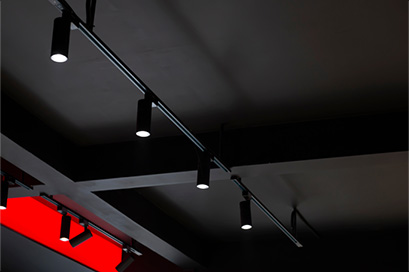




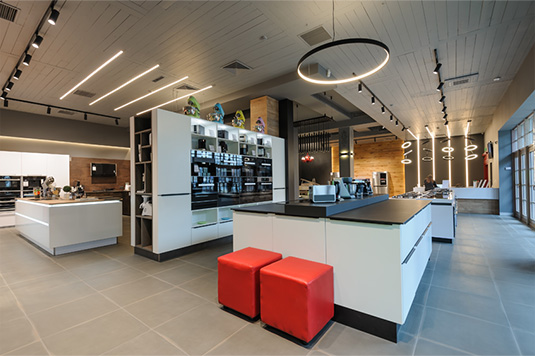

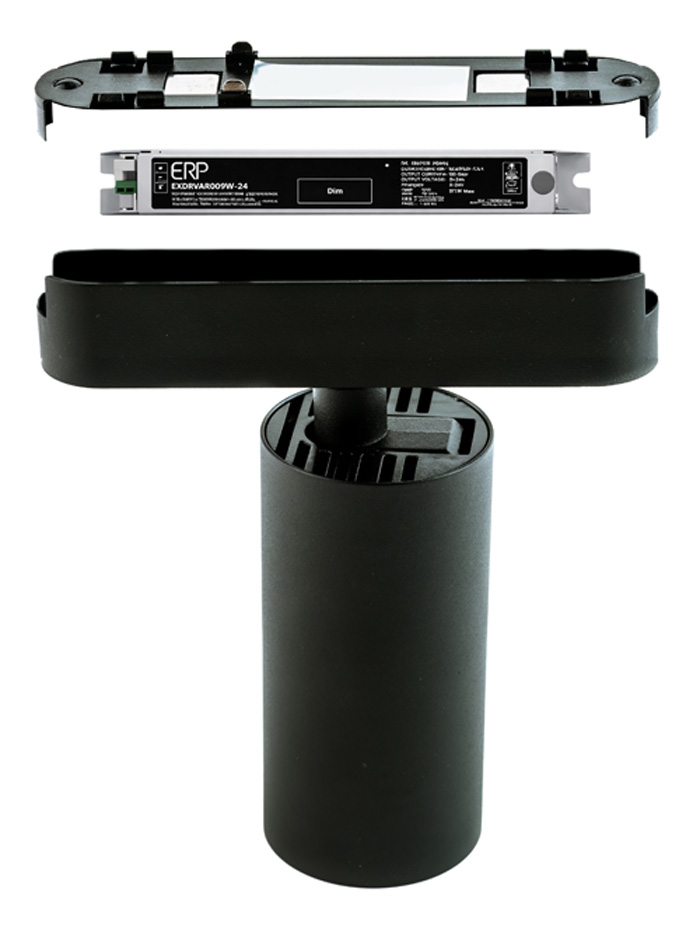
GaN-enabled power supply platforms deliver value at every level of the lighting ecosystem:
Lighting Designers: Smaller drivers free up space for innovative fixture aesthetics.
Manufacturers: Consolidated platforms reduce SKUs, complexity, and costs.
Installers: Snap-on extrusion drivers simplify wiring and speed up installation.
End Users: Higher lumens-per-watt mean lower operating costs and better performance.

Transitioning to GaN: Why the Time is Now
Although GaN technology has been around for more than two decades, it has been slow to make its way into the LED driver space. ERP made the decision to resist early transitions to discrete GaN devices because the cost-to-performance equation wasn’t compelling enough to justify a topology change.
It is important to note that a topology is inclusive of the whole lighting system, and GaN is only one factor of that total topology. ERP has developed an exceptional intellectual approach to the entire two-stage LLC topology it is currently using, and moving to a new high-density design requires a lot of skilled execution. Changing a topology is not something that ERP does lightly, and so the product must demonstrate significant cost and performance advantages when such changes are made.
Now however, the time has arrived. GaN integrated circuits and power components have enabled the technology to reach a point where efficiency, cost, and size advantages are finally aligned.
This disciplined approach, combined with ERP’s computing-industry experience in high-density design, has positioned ERP years ahead of traditional lighting competitors.
“It generally takes about four years for competitors to catch us. This technology pushes us another four years ahead.”
– Michael Archer, CEO, ERP Power
As GaN continues to reshape the industry, ERP is positioned not just to participate in the transformation, but to lead it.
Gallium Nitride is more than a semiconductor upgrade; it is pushing the industry to rethink what lighting technology can achieve. ERP Power is using GaN not in isolation, but as part of a holistic architecture that redefines the metrics of efficiency, density, and design flexibility.

Be on the cutting edge of higher efficiency power in the smallest package on the market. Contact ERP Power today to explore GaN-powered LED driver solutions designed for your needs.