

Decrease Material Waste and Expand the Lifespan and Efficiency of Your LEDs
LEDs have allowed lighting professionals and consumers alike to enjoy drastically reduced energy consumption, maintenance, and cost compared to incandescent or fluorescent lighting. Now, additional efficiencies are being captured at a deeper level—inside the electronics that power LEDs.
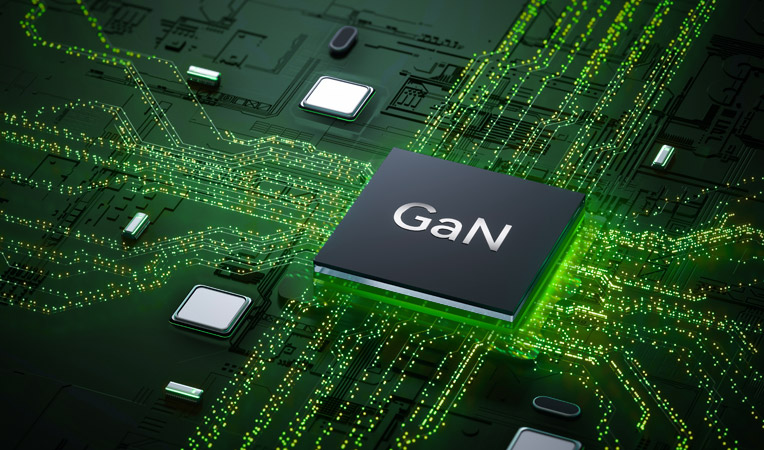
Gallium Nitride (GaN) technology is a wide-bandgap semiconductor material that is rapidly displacing traditional silicon. Its superior performance in speed, energy use, and power handling is paving the way for smaller, lighter, and more efficient components.
As the lighting industry pursues and prioritizes sustainability, GaN is emerging as a key technology for the next generation of lighting: small footprint, big power.
Sustainability Expectations and Capabilities in Modern Lighting
The conversation around sustainable lighting has been ongoing, prompting lighting manufacturers to consider a broader set of environmental factors beyond energy efficiency:
- The amount and type of materials used in electronic components
- Heat management
- Product lifespan
- Electronic waste
- Lifecycle carbon footprint
- Maintenance requirements
GaN has only recently become a viable solution for LED drivers, and ERP is pioneering this adaptation, integrating GaN into its next-generation LED driver platforms and setting a new standard in power density, efficiency, and lighting design flexibility.
Traditional LED Drivers: Rely on silicon-based power semiconductors and therefore are limited in their ability to deliver greater energy efficiency or a smaller driver size.
GaN-Powered LED Drivers: Operate at higher voltages, temperatures, and switching frequencies while losing less energy to heat.
GaN-powered transistors can switch up to 10 times faster than silicon, allowing for more compact and efficient driver designs, ultimately delivering greater flexibility in lighting design.
This flexibility — doing more with less “stuff” — creates sustainability gains across the lighting system. Sensors, dimmers, modularity, and adaptability help lower the environmental footprint while contributing to increased performance.
Immediate Energy Efficiency Gains
GaN-based LED drivers boast higher efficiency levels, faster switching frequencies, and smaller component sizes than silicon, thanks to its higher electron mobility and lower gate charge.
| Current GaN Technology | Previous Silicon-Based Designs | Legacy Driver Architectures | |
| Efficiency | 92% | 88% | 85% |
While these efficiency percentages may appear modest, the impact is substantial when applied to large lighting applications. Environments like commercial buildings, data centers, warehouses, hospitals, and industrial facilities use a significant amount of electricity, and even incremental improvements in driver efficiency can mean major reductions in energy use and carbon emissions.
For lighting designers and architects, as well as companies pursuing corporate ESG and sustainability goals, the long-term impact of GaN’s higher driver efficiency can mean:
- lower electricity costs
- reduced cooling loads from minimized heat generation
- improved overall system efficiency
Greater Power Density, Smaller Size, Greater Sustainability
GaN devices operate at higher frequencies, and therefore require smaller inductors, capacitors, and cooling components—all of which take up space in traditional driver designs.
Driver manufacturers like ERP can now design drivers that deliver more power in a much smaller size. The gains over previous silicon-based designs and legacy driver architectures are a leap in minimizing the form factor.
| Current GaN Technology | Previous Silicon-Based Designs | Legacy Driver Architectures | |
| Power Density | 25-30 watts per cubic inch | 20 watts per cubic inch | 8 watts per cubic inch |
Higher power density delivers a number of sustainability benefits:
Material Reduction. Smaller drivers require fewer electronic components and less enclosure material.
Lighter Weight. A smaller form factor reduces transportation emissions across the supply chain.
Manufacturing Efficiencies. Fewer and more compact components simplify the manufacturing process and lower production waste.
Increasing Product Longevity
Excess heat is a known enemy of an LED driver. Electronic components, driver reliability, and operational performance are all degraded by heat exposure, which begs the question—is there a better way?
GaN’s technology actually improves thermal performance by lowering conduction and switching losses and handling higher operating temperatures without performance degradation.
| Current GaN Technology | Previous Silicon-Based Designs | Legacy Driver Architectures | |
| Operating Temperature | Up to 300°C | Up to 175°C | Up to 85°C |
Its wide bandgap, higher electron mobility, and superior thermal conductivity allow smaller, more compact designs that require less complex cooling. Ultimately, an LED driver powered by GaN technology is more durable, and can power longer-lasting lighting systems.
The sustainability benefits with a longer driver lifespan include:
- Less heat generation → lower energy losses
- Improved reliability → higher temperature tolerance
- Reduced stress on components → more efficient switching
- Fewer replacements → minimized material waste
In large facilities with thousands of luminaires, extending driver lifespan can have a significant environmental impact over time.

The Lighting Design Evolution and Circular Economy Goals
Manufacturers, corporations, and architecture and design professionals are actively implementing or adhering to circular economy principles – making or using products that last longer, use fewer materials, and generate less waste.
Ever at the forefront of environmentally conscious design, ERP was quick to adopt GaN in support of circular economy principles; GaN delivers high efficiency and high reliability in a small package, reducing premature driver replacement and requiring fewer materials.
Even when the environmental impacts of the manufacturing process itself are considered, GaN’s operational benefits net out those impacts with energy savings and longer service life.
Perhaps not as intrinsic to a circular economy, but certainly critical for sustainability growth in the lighting sector: this is what GaN signifies for the next generation of lighting.
Smaller, higher-density drivers are setting a new benchmark for lighting design flexibility when integrating electronics into luminaires. Instead of designing around bulky driver enclosures, designers can now create more streamlined and compact fixtures that deliver on aesthetic and performance needs.
In addition, smaller drivers simplify installation by reducing wiring complexities and overall costs.
GaN is just the beginning of a new chapter in sustainable lighting that has evolved past the LED itself. With these sweeping advances in driver technology, high-energy efficiency, fewer materials, smaller and lighter drivers, and longer product life will be standard-issue for every luminaire.

Realize the meaningful sustainability gains you can achieve with GaN technology. Check out our GaN-powered LED driver solutions (PLH Series & PRH Series), designed to meet your high-performance lighting needs.